Amazon Associate link
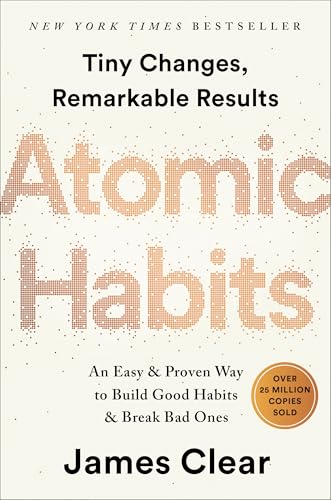
Atomic Habits
by James Clear · 2018
TL;DR — The Essence
Atomic Habits argues that meaningful, lasting change doesn’t come from willpower, motivation, or dramatic breakthroughs. It comes from tiny, consistent improvements — just 1% better each day — that compound over time into extraordinary results. The book’s central insight is deceptively simple: focus on systems, not goals, and redesign your identity before trying to change your behavior.
Key Lessons
1. The 1% Rule: Small Improvements, Massive Results
Most people underestimate tiny changes because results don’t appear immediately. But the math is unforgiving: improving 1% every day for a year leaves you 37 times better than when you started. The flip side is equally powerful — declining 1% daily means you’ll approach zero.
James Clear calls this the “aggregation of marginal gains.” British cycling coach Dave Brailsford used this philosophy to take a team that hadn’t won a Tour de France in over a century to dominating the sport within five years, by improving every element of performance by just 1%.
The problem is that the results of good habits are often delayed, while the costs of bad habits are equally deferred. You don’t feel unhealthy after one fast food meal, nor do you become fit after one workout. Time magnifies whatever you feed it.
2. Systems Beat Goals Every Time
Here is what most self-help books get wrong: goals are almost useless without the systems that produce them.
Both the winner and the loser of a championship had the same goal — to win. The goal didn’t differentiate them. The system of daily habits did. When you solve a goal, you only fix a problem temporarily. But when you build a system, you fix it permanently and continuously.
Clear’s formula: “You do not rise to the level of your goals. You fall to the level of your systems.” Goals set a direction; systems determine whether you make progress. A person who wants to run a marathon should focus not on the race, but on the daily routine of lacing up their running shoes every morning.
3. The Four Laws of Behavior Change
Every habit — good or bad — follows a four-stage loop: cue → craving → response → reward. Understanding this cycle gives you leverage to build any habit or destroy any vice.
To build a good habit, apply four laws:
- Make it obvious — Design your environment so the cue is visible. Leave your book on your pillow if you want to read before bed. Put your guitar stand in the middle of the room, not in the closet.
- Make it attractive — Pair the habit with something you enjoy. Only listen to your favorite podcast while exercising.
- Make it easy — Reduce friction. Prepare your gym bag the night before. Use the Two-Minute Rule: start with a version of the habit that takes less than two minutes.
- Make it satisfying — Reward yourself immediately. Track your progress with a habit tracker and enjoy the satisfaction of marking an X on the calendar.
To break a bad habit, simply invert each law: make it invisible, make it unattractive, make it difficult, and make it unsatisfying.
4. Identity Is the Foundation of Every Lasting Habit
This is the most counterintuitive and powerful idea in the book. Most people try to change their outcomes first (lose 20 pounds), then their process (go to the gym), and never touch their identity. Clear argues the order must be reversed.
The most lasting behavior change starts with identity change. Instead of “I want to run a marathon,” the internal statement becomes: “I am a runner.” Every action you take is a vote for the type of person you believe you are. Two votes for the runner, three votes for the runner — over time, the evidence accumulates and the identity solidifies.
This is why so many people fail: they try to achieve outcomes while holding onto an identity that contradicts them. The smoker who wants to quit but still thinks of themselves as “a smoker who is trying to quit” is fighting against their own self-concept with every craving.
5. Environment Design Beats Willpower
Willpower is a finite and unreliable resource. Professional athletes, executives, and highly productive people don’t rely on motivation — they engineer their environment so that the right behaviors are the default and the wrong behaviors require extra effort.
Want to eat less junk food? Don’t keep it in the house. Want to read more? Put a book on your desk and remove your phone charger from beside the bed. The context in which a habit occurs is one of its most powerful cues. New environments are particularly effective for building new habits because they’re free of competing cues from old habits.
6. The Two-Minute Rule
When starting any new habit, scale it down until it takes less than two minutes to complete. “Read before bed” becomes “read one page.” “Do yoga” becomes “put on my yoga mat.” “Study Spanish for 30 minutes” becomes “open my Spanish textbook.”
This sounds absurdly simple. That’s the point. The goal is to make the habit the kind of thing that’s almost impossible not to do. Showing up — the ritual itself — matters more than the performance in the early stages. Once the identity of “someone who does this” is established, expanding the habit becomes natural.
7. Habit Stacking
One of the most reliable ways to introduce a new habit is to connect it to an existing one. The formula is: “After I [CURRENT HABIT], I will [NEW HABIT].”
After I pour my morning coffee, I will meditate for two minutes. After I sit down at my desk, I will write three sentences. After I close my laptop at night, I will read ten pages.
Existing habits are already wired into your brain with strong contextual cues. By stacking new behaviors onto them, you borrow the established neural pathway and momentum of something you already do automatically.
8. The Goldilocks Rule: Stay in the Zone
Humans experience maximum motivation when working on tasks at the edge of their current abilities — not so easy they’re bored, not so hard they’re anxious. Just right.
As habits become automatic, boredom becomes the real threat. The professionals who reach the top of their field are those who find a way to stay engaged when the work becomes routine. The difference between a master and an amateur is the ability to show up on the days when the work doesn’t feel exciting.
Notable Quotes
“You do not rise to the level of your goals. You fall to the level of your systems.”
“Every action you take is a vote for the type of person you wish to become.”
“The secret to getting results that last is to never stop making improvements. It’s remarkable what you can build if you just don’t stop.”
Who Should Read This
Atomic Habits is for anyone who has tried to build a habit and failed — which is most of us. It’s especially valuable for people who have relied on motivation and willpower, only to find those resources exhausted. The book bridges behavioral psychology, neuroscience, and immediately actionable technique.
It’s a particularly good read if you’re starting a new phase of life (new job, new year, new project) and want to build systems rather than chase goals. The insights apply equally to fitness, professional work, learning, relationships, and financial habits.
If you’ve read other habit books and found them vague on the how, Clear’s specificity and concrete strategies set this apart.
Frequently Asked Questions
What is the main message of Atomic Habits? The core message is that small, consistent improvements — just 1% better each day — compound over time into remarkable results. Change your identity first, then build systems aligned with that identity, and the outcomes take care of themselves.
What are the 4 laws of behavior change in Atomic Habits? The Four Laws are: (1) Make it obvious, (2) Make it attractive, (3) Make it easy, and (4) Make it satisfying. To break a bad habit, invert each law.
How is Atomic Habits different from other self-help books? Most self-help books focus on goals and motivation. Clear’s approach centers on systems, environment design, and identity — more durable levers than willpower. The book is unusually specific in its actionable advice.
Is Atomic Habits worth reading? It consistently ranks among the most practical and impactful books in the personal development genre. The concepts are research-backed, well-explained, and immediately applicable. Most readers report changing at least one meaningful habit within weeks of reading it.
Ready for the full experience?
Buy on Amazon →As an Amazon Associate I earn from qualifying purchases.
Get the Full Book on Amazon
The definitive guide to building good habits and breaking bad ones through tiny 1% improvements that compound into extraordinary results.
Buy on Amazon →As an Amazon Associate I earn from qualifying purchases.